The Duc's Ball
On discovering that the new owner of Fielden whisky is the great-great-great-great-grandson of the Duc de Stacpoole, and with apologies to Richard O'Brien...
“I have never been a quitter…” droned a familiar voice on the radio as a third motorcycle shot past in the other lane. John shifted slightly in his seat, leaning forward, staring intently through the windscreen, and chewing heavily on his spearmint gum. The wipers flapped back and forth, trying their damnedest to clear the heavy rain.
And then…
Nothing.
The radio cuts out. The car loses power, and John pumps hopelessly at the accelerator as they drift to a stop. Harriet removes the Fruit and Nut bar from her open mouth and turns to look at her fiancé.
“Damn it!” He slapped the steering wheel. “I knew I should have gotten that spare tyre fixed.”
“The spare won’t help if the engine’s dead,” Harriet answers, peering through the passenger window. The rain was coming down harder now. Fat drops that hammered the roof and turned the windscreen into a running blur of sodium orange soda.
“You just stay here and keep warm,” John said, reaching for his jacket. “I’ll go find help.”
“Where? We’re in the middle of nowhere.”
“We must have passed something. A house. A pub. These bikes must be coming from somewhere…”
“We haven’t passed anything for miles.” Harriet was already pulling on her coat. “I’m coming with you.”
“Oh no, darling. There’s no sense in both of us getting soaked. And besides, someone might stop.”
“But what if you find the owner of a phone – a beautiful woman - and you never come back again. I’m coming with you.”
John looked at her, “Oh, darling. We’d just keep warm until help arrived.”
Outside, the rain drummed on like a confused marching band. He grabbed the newspaper from the back seat and split it in two. Passing half to Harriet, he held the remainder over his head as he got out of the car.
The forest pressed in on both sides of the narrow road. Oaks and beech trees dripped into the dark pool of the soaked lay-by. John’s shoes squelched in the mud. Harriet’s were already coated.
“Wait…” she said, pointing. “Look. There’s a light…through there…”
Between the trees, off to their left and barely visible through the rain, a warm glow flickered daintily against the sky.
“Candles?” John suggested.
“Or lanterns.” Harriet was already moving that way. “Come on.”
They pushed through the brambles. The newspaper was abandoned, and rain was soaking through their clothes. The forest floor was soft underfoot. Decades, centuries of leaf mulch turned to black sponge. As they drew closer, the light grew stronger, and with it came the smells – grain, ginger biscuits, and apple pie. Warm smells. Welcoming smells.
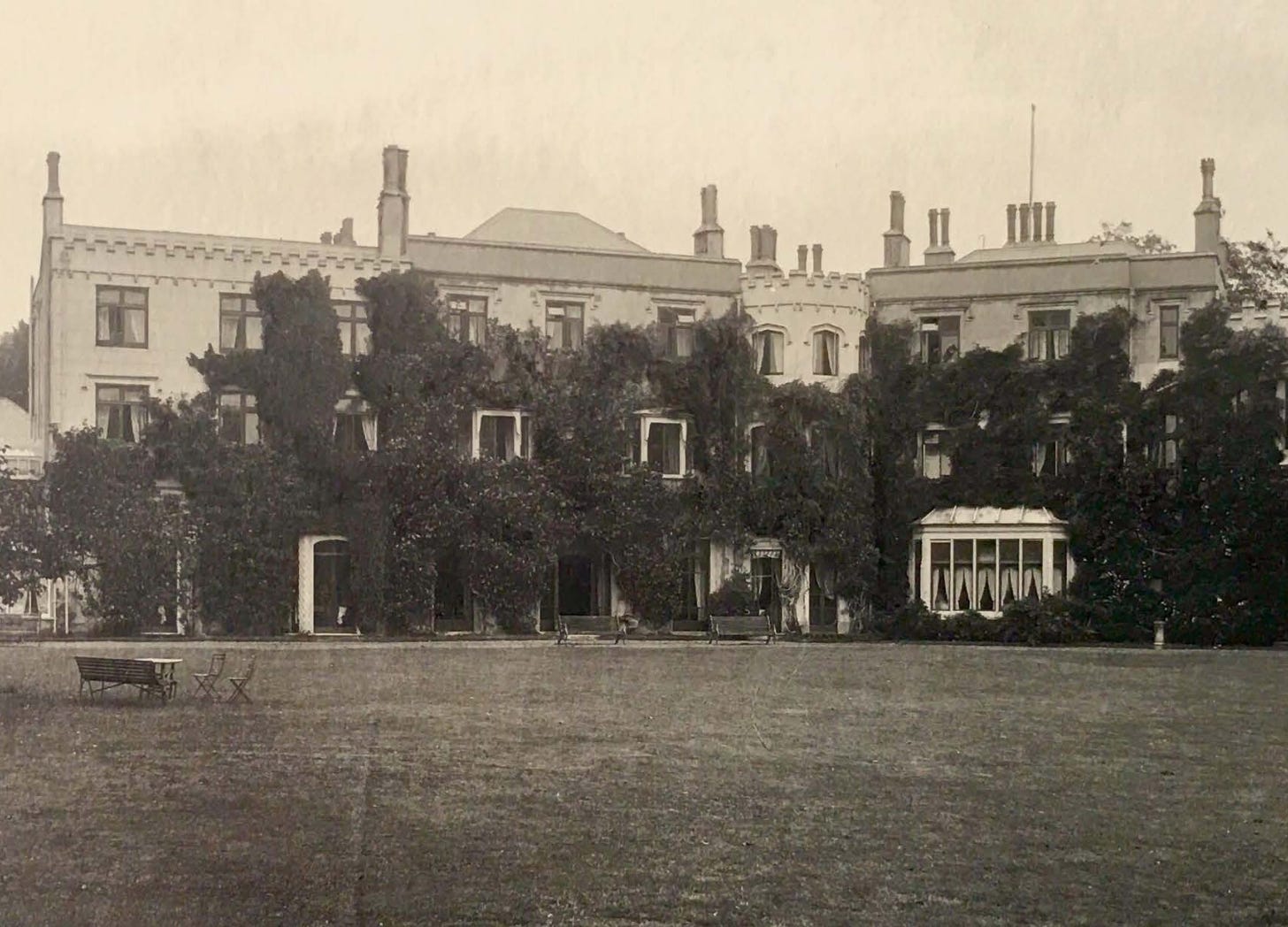
The house appeared suddenly, as if the trees had thought to hide it and then thought again. Mock-Tudor, castellated, gables and dark brick, but with every window glowing in amber. Music drifted from inside – orchestral strings. Something old-fashioned. A waltz, was it?
John hesitated at the gate. “Are they having a party?”
“So what? They must have a phone.” Harriet was already through it and up the gravel path towards the solid-looking oak door.
There was a brass knocker in the shape of a ship’s anchor, three ropes entwined around its stock. Before he had time to think, John had lifted it and let it fall three times.
The music stopped. Silence. Then footsteps. Deliberate.
The door opened.
A man stood, filling the opening. Vertically at least. He was tall and thin, with a slight stoop. He wore dark clothes – a butler’s livery, although the cut seemed oddly old-fashioned. Not that you saw many modern liveries on the High Street these days. His face was pale, almost bloodless in the candlelight. He held a small ornate bowl of toffees, caramels and nuts.
“Good evening,” he said in a flat, measured voice. “You appear to be wet.”
“Our car broke down,” John stammered. “Just down the road. “We were hoping we could use your telephone?”
The man angled his head slightly. “A breakdown, you say? A telephone. I see.” He paused, as if considering. “I’m afraid that may be…difficult. But you are welcome to wait. To dry yourselves.”
“We don’t want to intrude,” Harriet said quickly. “If you’re having a party…”
“You’ve arrived on…ah…a rather special night.” The faintest suggestion of a smile played on the pale lips. “It’s one of the master’s…affairs.”
“Oh.” Harriet glanced at John. “How lovely.”
“Indeed.” The butler stepped aside, gesturing them in. “It’s not often we receive visitors here, I’m afraid. Let alone offer them hospitality. But please…”
John and Harriet exchanged a look. Behind them, the rain was hammering down, and the forest was pitch black. Inside was warm, dry and stocked with plenty of food.
“We don’t want to interfere with you…err, affairs,” John said.
Harriet touched his arm. “This isn’t a board meeting at a brand development agency, John. They’re being kind.” She looked earnestly at the butler: “Thank you.”
They stepped into the hallway. A long wood-panelled space lit entirely by candles. Dozens – no, hundreds – of them. In sconces along the walls, clustered on ornate sideboards, and in overflowing candelabra encrusted with decades of pale wax. The light reflected back at them from dusty, tarnished, gilt-framed mirrors, and the air smelled of fresh sourdough, black pepper and sweet spice, along with the smells from outside, stronger now: toasted grain, fresh herbs and apple pie with vanilla custard.
“I am Graves,” intoned the butler. “Captain Graves. Although the rank is somewhat… historical. If you follow me, the master will wish to welcome you.”
“We really don’t need to meet anyone,” John started. “Just make a call…” but Graves was already walking down the corridor.
Harriet squeezed John’s hand. “They’re probably foreigners,” she whispered. “This is their special night. They’ll have different ways…”
“I’ll be polite,” he whispered back.
The corridor opened into a large room. A ballroom, also panelled in dark wood, also lit by candles from three enormous chandeliers. The floor was polished oak, and at the far end, a quartet played on a raised proscenium. The music had resumed, and a waltz washed over the room, slow and stately.
Between the door and the stage were people. Dozens of them. Men in tailcoats and winged collars, women in gowns with bustles and elbow-length white gloves. They stood in clusters, talking in low voices, or swayed slowly on the dance floor. Every one of them looked as if they’d stepped out of a painting from the 1840s.
“Good God,” John muttered. “Is this a costume party? What a place…”
Before Harriet could answer, a deep voice rang out from across the room
“Ah! Our wayward travellers!”
The crowd parted, and a man approached. He was perhaps fifty, broad-shouldered, with dark hair greying at the temples and a face that might have been handsome if it wasn’t for a little hardness around the eyes. He wore decorated evening dress – a white waistcoat, a black tailcoat, ornate medals, a sash and a cravat tied in an elaborate knot. In one hand, he carried a thick crystal tumbler half-full of amber liquid.
He stopped in front of them and smiled. It didn’t reach his eyes, stopping somewhere at a hard border his face had long-ago erected.
“Welcome,” he said, his accent faintly foreign. French, perhaps? Although with something else beneath it. “I am Richard, once Vicomte de Stacpoole, Marquis of the Papal States and first Duc de Stacpoole, thanks be to His Holiness Gregory XVI. Though you may call me Richard.” He gave a small, semi-ironic bow. “This is my house. Or was. Or is. Time becomes somewhat…fluid on nights such as these.” He gestured around the room.
“Pleased to meet you. I’m John. This is Harriet. We didn’t mean to…”
“Nonsense.” Stacpoole waved a white-gloved hand. “It’s the seventh of July. We always celebrate on the seventh. Graves, fetch glasses for our guests. They’ll need something with some…substance.”
“At once, sir.” Graves melted away into the shadows.
“Please. Don’t stand on ceremony. It’s not easy having a good time, but we do our best…ahaha.”
Harriet looked around. The dancers were moving in perfect unison, their faces expressionless. The musicians played without looking at their instruments. No one was talking above a whisper. No one was laughing.
“What are you celebrating?” she asked.
Stacpoole’s smile widened, straining at his cheeks. “Ah, an anniversary. You might say a significant one.” He sipped his whisky. “I would like, if I may, to take you on a strange journey. But first – you simply must have a drink.”
Graves reappeared carrying a silver tray with two glasses. The liquid inside was pale gold, appearing almost Verdigris in the candlelight. Stacpoole took one and handed it to Harriet, then gave the second to John.
“Try it.” Stacpoole said quietly, then boomed, “IT IS OF THE FIELD”, to which the partygoers raised an almost raucous cheer. “Do you understand me? Not of the distillery. Not of the warehouse. Of the field itself. Earth and grain and water and time. Worms and wildflowers, barley, rye and wheat. Maslin. Everything that grows must one day decay. Everything that is hidden must eventually reveal itself again.” He raised his own glass. “Come. Give yourself over to the pleasures of the field. Just for tonight.”
John lifted the glass to his nose. Wildflowers, brambles – sweet and hedgerow fresh. Underneath, caramel, hazelnut, fresh bread. Something darker. Black pepper, orange marmalade, toasted grain.
“What is this?” he asked.
“Something very old,” Stacpoole said. “Something I’ve been saving. Smuggled it myself back in the day…ahahaha. The excise men came for me in ’47, you know. Barricaded myself in the tower with a cavalry sabre,” he explained with a pirouette, carving a perfect simulacrum of a Zorro-Z in the air. “Made all the papers.” He chuckled. “But they never did find all the tunnels.”
“Tunnels?” Harriet asked. “Forty-seven?” queried John.
“Oh yes. Connect the house to Lyndhurst. To every pub. Hollows under the floorboards, catches and caches behind the panelling. Very convenient. Very convenient.” He sipped his whisky. “Of course, after I died, the smuggling continued for years. Force of habit, I suppose. The house remembers.”
Harriet sipped. The whisky was warming and complex. It tasted like the forest outside, with wildflowers and flaky pastry.
“It’s wonderful,” she said.
“Yes,” Stacpoole replied. “Isn’t it?”
The music swelled, and dancing couples swirled, their movements slow and dreamlike. John felt the warmth of the whisky spreading through him. There was something he wanted to ask Richard. About a phone? About something he’d said, but instead he could feel a tightness in his chest loosening.
“Perhaps,” Stacpoole said, extending a long hand to Harriet, “you would honour me with a dance?”
John started to object, but Harriet was already setting down her glass, smiling and taking Stacpoole’s hand.
“Don’t worry, darling,” she called over her shoulder as Stacpoole led her out into the middle of the floor. “We’re just keeping warm until help arrives.”
John watched them join the other dancers. Graves appeared at his elbow and refilled his glass from a decanter without asking.
“How long,” John asked quietly, “has this party been going on?”
“Since 1848, sir. Every seventh of July. The master is very particular about certain traditions.”
John’s hand tightened on his glass. “1848?”
“Indeed. The night of his death, sir.” Graves smiled thinly. “Though death, as you can see, is something of a technicality.”
John opened his mouth. Closed it and looked at Harriet spinning slowly in Stacpoole’s arms. She was laughing now, her hair coming loose from its pins. The whisky glass in his hand had somehow refilled itself again.
The music played on, the candles flickered.
And outside, in the forest, the rain continued to fall on the deserted road where a Morris sat abandoned, its doors hanging open, headlights dead. A half-eaten bar of Fruit and Nut on the passenger seat as if it and the car had been there for a very long time indeed.
Fielden English Rye Whisky is made from an annual maslin (a mixture of different grains, particularly wheat and rye, which are grown together) and has notes of wildflowers, brambles, flaky pastry, caramel and hazelnut, fresh bread, black pepper and spearmint. Its name comes from the Old English for ‘of the fields’, and the brand has recently been purchased by GHF, a brand development agency run by Tristram Coates, the great-great-great-great-grandson of our eccentric Duke.
Now Richard Stacpoole had an interesting life. His father, George, was a close friend of the future King Louis XVIII, so close, in fact, that he lent Louis the money for his coronation after the overthrow of Napoleon and the restoration of the Bourbon dynasty to the throne of France. Shortly thereafter, George was made a Count of France by Louis as thanks for his “substantial contributions to the public debt”.
Richard, who had adopted the style of Vicomte de Stacpoole (without any real authority), married Elizabeth Tulloch, a descendant of the last Laird of Tannachie in Morayshire and faced a significant battle for the inheritance of his father’s estate. Sadly, some doubt was cast by the French courts as to the possible indiscretions of his mother, who was ‘known to visit taverns’ – gasp!
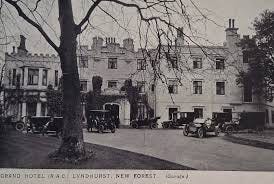
Having lost the title of Count as a result of this, Richard went to Rome, where he contributed £40,000 for the restoration of the Papal Basilica of Saint Paul Outside the Walls, for which troubles he was made a Marquis of the Papal States. He then paid for a bridge over the Tiber and some Roman fountains and was upgraded to a Duke before returning to England, where he made his home at Glasshayes, a stuccoed, castellated mock-Tudor house at Lyndhurst in Hampshire. There, he lived with his friends Captain and Mrs Graves and engaged in a little light smuggling. When excise agents raided the property in 1847, the Duke barricaded himself in the octagonal tower with a cavalry sabre - a siege widely reported in national papers at the time.
He died, aged 51, on 7 July 1848, leaving £1,000 a year and a life interest in Glasshayes together with its contents, a phaeton, ponies, horses and harness to Mrs Graves, with the remainder to his children. Since then, various witnesses have reported sightings of his ghost – either when changes are made to the house, or in the ballroom each year on the anniversary of his death, when music plays for his annual party. Those who attend, it’s said, rarely leave before dawn. Which is rather awkward, as the house was, for a long time, a hotel. A hotel, indeed, that Sir Arthur Conan Doyle once stayed in and decided to redesign for the owners. So perhaps this should have been an homage to Sherlock Holmes instead.